Bee-Centricity: Fox Hive Preservation
- Oct 10, 2016
- 3 min read

The Autumn is rife with people calling about hives that they feel should be removed or rescued. Four out of five times, these are for yellow jackets or wasps who are at their peak populations and flurry and soon set to die out. Sometimes they are for colonies that have created odd perches within or on a structure. The summer was delightful for the people as they watched the miracle of comb development, honey making and, oh the sound! But the first crisp apple days of fall appear and it dawns on us that this hive may need to be "saved."
October honeybee populations are beginning to subside but are still large. More bees are hanging out on the home front as there is less foraging and the increased guarding and scouting makes them more interactive with people. Sometimes they have formed exposed colonies high up in a tree or on the outside of a building. Many times homeowners or business owners decide that they need to be removed at this time of year. Removing comb from on or within a structure is called an extraction; extractions are about cutting up the colony and moving the parts to hive boxes and a new territory. This is the most invasive, challenging and brutal experience a human:hive interaction can get. I feel to the bees that they perceive it as a bear mauling and they will be highly likely to immediately abscond due to the trauma.
So what do we do?
I always counsel first to save the colony. Just leave it in the chimney, wall, tree what have you! A a man with recent extraction call was quickly enamored with the idea of cutting a hole out of the interior sheetrock and replacing with a shuttered piece of plexiglass to that he can watch the bees growing and thriving within the wall! This is ideal and wonderful!
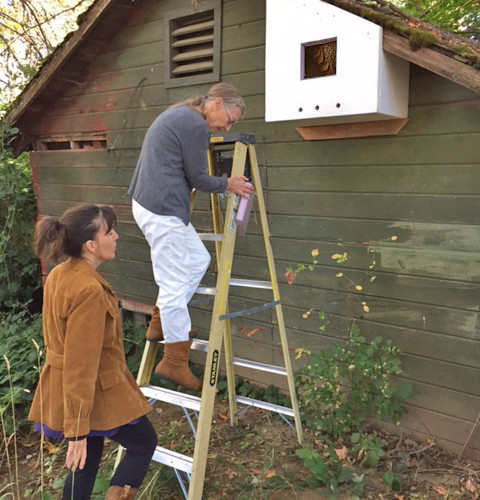
Our most recent "rescue" came from a family by the name of Fox, who wondered what should be done about a fanstastic colony growing on the eave of their barn. When we investigated we discovered that several colonies had all taken up residence between the wall joists, each spring's swarm taking up residence along the barn wall accessing old knotholes in the wood. This year's swarm decided to grow under the eave throughout the warm Southern Oregon summer and was sure to die of exposure if not cared for in some way.
So our team gathered to review the situation and it was quickly decided to NOT remove them. Not only do we have a risk of trauma-induced absconding, we will certainly destroy stores and brood in the process, maybe even the queen, leaving them far more vulnerable to winter's ravaging. So what do we do? Well, we insulate them of course!
We created a foam box, painted white and secured it to the sofit with screws. A support bar was placed underneath and a large board was placed over the top to provide additional weather protection. The box was tilted toward the wall to allow water to drain if there is seepage or condensation. The space between boards provided a series of ventilation holes along the sides that the bees can open or propolize, the top edges were not entirely flush and three entrance holes were placed in the front: all contributing to adequate ventilation of manageable sizes for the bees to correct if necessary.
We also cut an observation window that can be removed once in a while to check on the health of the colony.
This is a single season solution and the homeowner has pledged to use this box as a model to build a more permanent structure for them, set up on a permanent platform.
Bee-Centric Beekeeping is all about working WITH the bees. We can think outside the box and invent solutions, always breaking it down to the least invasive and most supportive methodologies possible.






Comments